

The Hidden Complexity Behind Hardware Innovation
On paper, a hardware project can look simple: design a board, manufacture it, test it, and move forward.
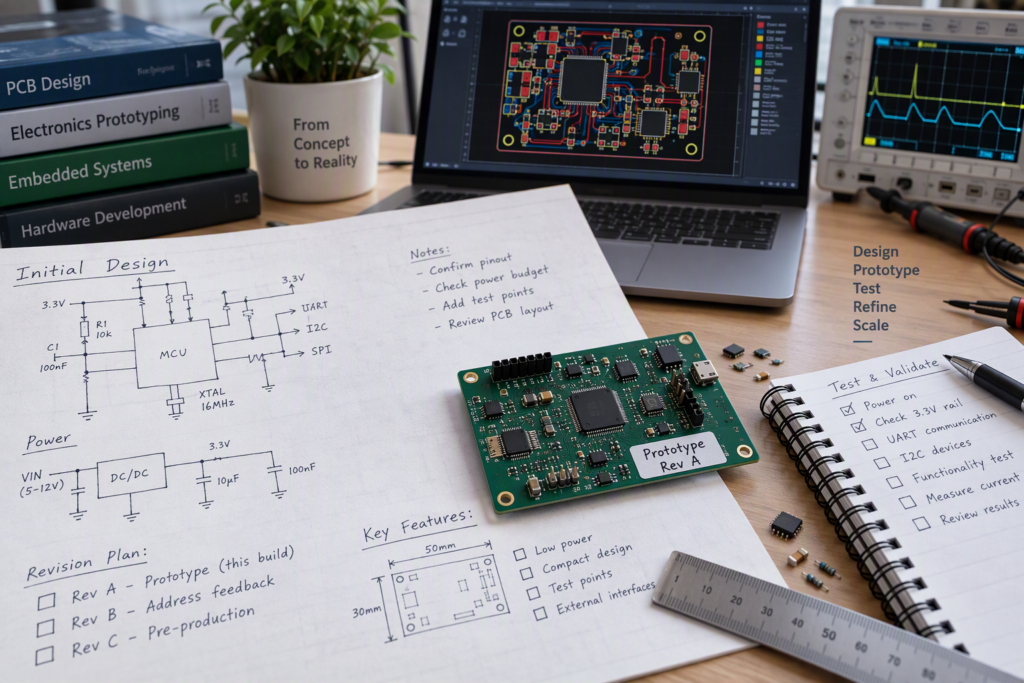
In reality, the process is far more iterative. Most projects begin with a prototype, where an initial design is transformed into physical hardware for the first time. That prototype then becomes the starting point for a cycle of testing, learning, and refinement.
A single board can go through multiple iterations of:
- Initial design and layout
- Prototype build
- Testing and validation
- Failure analysis and feedback
- Redesign and rework
- Further prototype and pre-production builds
- Production readiness
These cycles are not exceptions, they’re the norm.
Across programmes we’ve supported for global semiconductor companies, including system-in-package (SiP) evaluation platforms and advanced test boards, this iterative loop is constant. From early prototypes through to production-ready hardware, each revision brings new insights and each issue uncovered helps move the product forward.
Where Innovation Slows Down
While design teams are focused on performance and functionality, progress can often stall elsewhere. From our experience, the biggest challenges tend to be:
- Coordinating between multiple stakeholders
- Managing changes across design and manufacturing
- Handling returns, rework, and quality feedback
- Maintaining visibility across different build iterations
These are not purely technical problems. They are operational challenges, ones that can slow projects significantly if not managed properly.
In several programmes we’ve supported, including high-spec evaluation boards for semiconductor partners, progress depended not just on solving engineering questions, but on keeping the entire process aligned and moving.
The Role of SMEs in the Global Tech Ecosystem
This is where SMEs play a critical role. Large technology companies are experts in design, architecture, and system-level innovation. But delivering hardware at speed requires a different kind of capability—one built around flexibility, responsiveness, and close coordination.
SMEs operating in the electronics manufacturing space often sit right in the middle of this process. They connect:
- Design teams and manufacturing partners
- Engineering intent and production reality
- Prototype development and scalable delivery
In practice, this means supporting everything from early-stage builds through to repeat production cycles.

Working at the Edge of Innovation
In recent years, we’ve seen increasing collaboration between SMEs and global technology leaders on projects involving:
- Evaluation and development boards
- Advanced packaging platforms such as SiP
- High-performance driver and test boards
- Early stage hardware for emerging applications
These projects are typically dynamic, with evolving requirements and tight timelines. They demand not only technical capability, but also the ability to adapt quickly as designs change. Even in cases where builds need to be returned, reworked, or adjusted, the focus remains the same: keep progress moving, ensure lessons are captured, and deliver the next iteration better informed than the last.
From Transactions to Collaboration
One of the biggest shifts in the industry is how these relationships are evolving. Hardware development is no longer a linear process where a design is handed over for manufacture. Instead, it has become a collaborative cycle.
SMEs are increasingly acting as:
- Coordinators across the supply chain
- Technical partners providing manufacturability insight
- Problem solvers when unexpected issues arise
This shift is particularly evident in projects where multiple revisions, component challenges, or performance issues need to be addressed quickly. The value is not just in delivering a finished board, it’s in enabling the process that gets it there.
Why This Matters for Innovation in Ireland and elsewhere
Ireland has a strong and growing position within the global technology ecosystem, particularly in semiconductors and advanced manufacturing.
Smaller, agile companies are a key part of that ecosystem. Their ability to:
- Respond quickly
- Manage complexity
- Support global programmes
…makes them essential partners to large international organisations.
Ireland has also recognised the importance of helping SMEs participate in larger innovation programmes. Initiatives that connect smaller companies with multinational organisations, research institutions, and emerging technology projects are helping create new opportunities for collaboration and growth. As innovation cycles continue to accelerate, the role of SMEs in supporting hardware development, prototyping, and manufacturing will only become more important.
A Final Thought
In hardware development, success is rarely defined by a single breakthrough. It’s defined by the ability to keep moving forward through iterations, challenges, and constant refinement. Innovation doesn’t fail at the design stage. More often, it slows down or stalls in the execution.
Large breakthroughs are often built on hundreds of small challenges overcome along the way. SMEs play a critical role in helping hardware programmes navigate those challenges and keep innovation moving.